Agility – How to improve change of direction in youth, beyond the cone drills
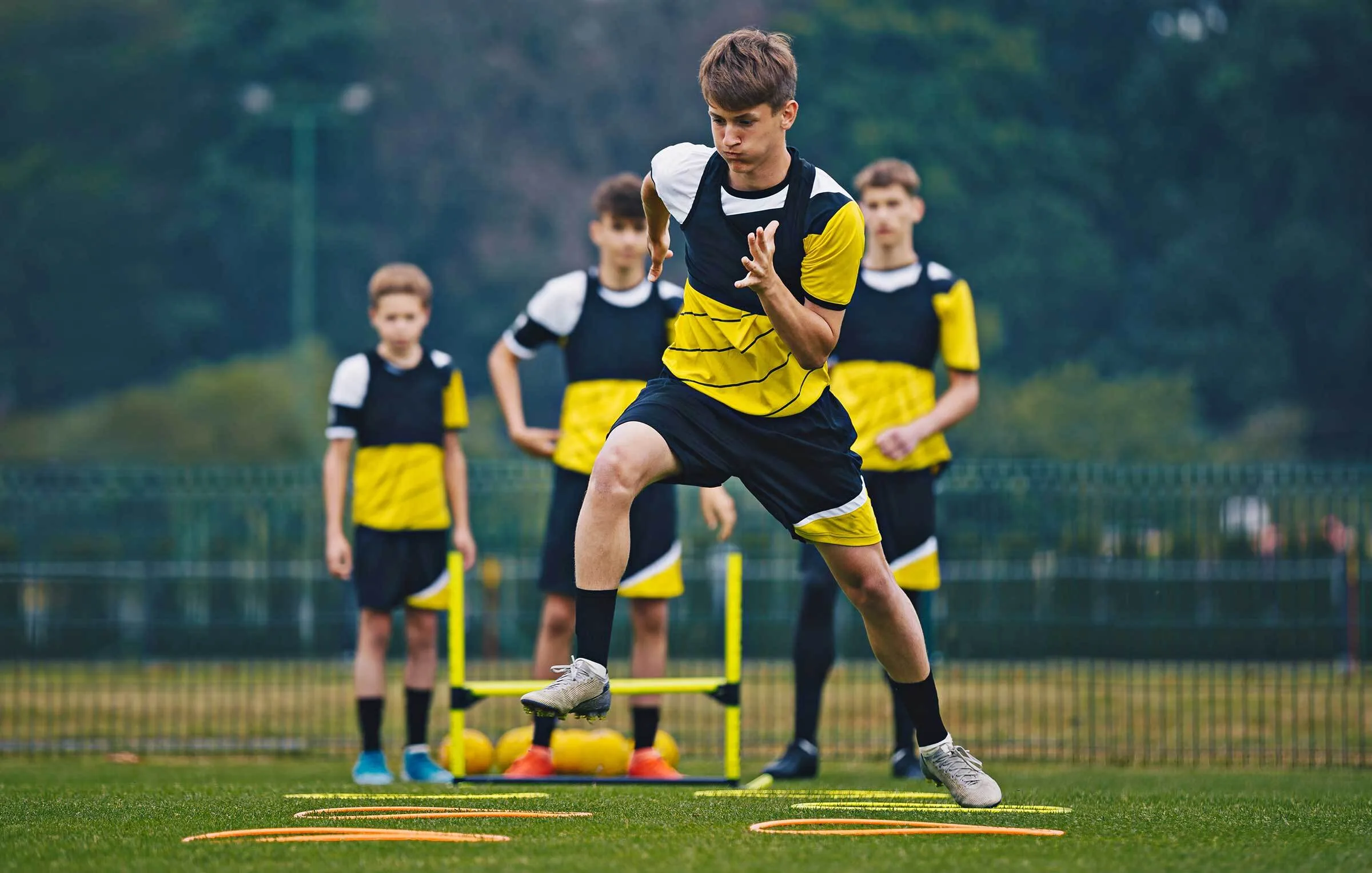
Walk into any junior sports session and you’ll probably see cones lined up in perfect symmetry. Zig-zags, ladders, and figure-eights. All in the name of “agility.”
But here’s the truth: real agility is more than just moving quickly around cones.
Especially in youth athletes, change of direction (COD) is a complex skill that combines strength, technique, and reactive decision-making.
If we want to develop athletes who can move well in the chaos of sport, we need to move beyond choreography and start building a base of movement literacy, strength, speed development and adaptability.
What Is Agility, Really?
In sport science terms, agility is the ability to change direction or velocity in response to a stimulus. That second part — the stimulus — is key. Because in most sports, athletes don’t know exactly when or where they’ll need to change direction. They read cues, make decisions, and react under pressure.
That’s why reactive drills and strength development are so much more effective than closed drills alone.
Key Concepts in Preparing for Agility and Change of Direction
Agility and change of direction (COD) are essential for athletes across various sports. To excel in these areas, key concepts include:
-
Footwork: Efficient foot placement helps in quick shifts and stable transitions.
-
Core Strength: A strong core enhances balance and control during rapid directional changes.
-
Reaction Time: Quick reflexes are vital for initiating movements swiftly.
-
Explosiveness: Power and speed are necessary to move in different directions rapidly.
-
Deceleration: Controlled slowing down enables safe and effective transitions.
-
Flexibility: Good flexibility aids in fluid and smooth movements during changes in direction.
Mastering these concepts improves both agility and overall athletic performance.
Strength is the Driver of Movement Quality
You can’t separate agility from strength. The ability to brake, plant, and re-accelerate all depends on force production and absorption.
Studies like Serpell et al. (2010) and Young et al. (2015) show that strength, particularly eccentric and unilateral strength, is a major contributor to COD ability in youth. Without strength, athletes collapse into every cut, leak energy, and risk injury.
Exercises like split squats, lateral lunges, isometric holds, and soft tissue eccentrics build the physical qualities that support stable, repeatable movement patterns.
This is especially important during periods of rapid growth, when coordination temporarily drops and athletes become more vulnerable to injury. Strength keeps them resilient.
Effective Change of Direction Drills for Youth Athletes
Mechanics Before Mayhem
The second major piece is movement mechanics. Youth athletes need to learn how to decelerate with control, how to create positive shin angles, and how to keep posture and integrity during lateral movement.
Just like we teach sprinting mechanics, we must teach COD mechanics. For example:
- Push off the inside edge of the plant foot
- Keep hips and shoulders square during redirection
- Lower the centre of mass before cutting
- Adding overall dynamic stability
These are not automatic. They must be taught early, then repeated and progressed as athletes mature.
Add the Chaos Later
Once strength and movement patterns are in place, then it’s time to introduce chaos. Games like mirror tag, ball-react drills, or light-response COD games add the decision-making layer.
This is where sport lives. Athletes must adjust on the fly, make choices, and react to cues. This is also where physical and cognitive development meet, so as per speed, physical and emotional maturation make a big impact too!
The Takeaway
Agility in youth sport is not just about speed or fancy footwork. It’s about building the physical strength, technical shapes, and perceptual decision-making that transfer to sport.
Don’t just run cone drills.
Teach strength.
Coach movement.
Introduce chaos at the right time.
The outcome? Athletes who don’t just move fast — they move with purpose, control, and confidence. Check out our youth agility and speed classes here.
Staggered Shuttle Drill: Enhancing Agility and Speed
The Staggered Shuttle Drill is a dynamic exercise designed to improve an athlete’s agility, speed, and ability to change direction quickly. In this drill, markers or cones are placed in a staggered pattern, typically in a straight line or slight curve, at varying distances (e.g., 5-10 meters apart). The athlete sprints to the first cone, then quickly changes direction and sprints to the next, continuing through the staggered pattern. The athlete can add different footwork variations, such as side shuffles, backpedals, or diagonal runs, to further challenge their movement and reaction time.
This drill helps athletes build better cardiovascular endurance, lateral movement, and quick decision-making, making it highly effective for sports that require fast direction changes, like football, basketball, and soccer.
FAQs
What is the ability to change direction quickly?
The ability to change direction quickly is called agility.
What is the ability to change quickly called?
The ability to change quickly is often referred to as quickness or reaction time.
What is the ability to move quickly and change direction called?
This ability is called agility.
What is the ability to move quickly called?
The ability to move quickly is called speed.
What is the ability to change quickly?
The ability to change quickly is typically referred to as quickness or reactive agility.
What is the ability to move quickly in one direction?
The ability to move quickly in one direction is called sprint speed or simply sprinting
What are change of direction cone drills?
Exercises where athletes move quickly through a series of cones to improve agility and direction changes.
Why are cone drills important for agility training?
They improve quick movements, reaction time, coordination, and footwork.
How do I perform a basic cone drill?
Sprint to each cone, change direction quickly, and continue to the next cone.
What muscles do cone drills target?
Legs (quads, hamstrings, calves) and core muscles.
How can I improve my performance in cone drills?
Focus on proper form, quick reactions, and gradual speed improvement.
Can cone drills help with sports performance?
Yes, they enhance agility for sports requiring quick direction changes.
How often should I do cone drills?
2-3 times a week for optimal improvement.
What are some variations of cone drills to increase difficulty?
Add lateral movements, backpedals, or sprints for more challenge.
Can cone drills help with injury prevention?
Yes, they improve balance and deceleration, reducing injury risk.
Are cone drills suitable for beginners?
Yes, beginners can start with simpler patterns and longer distances.