Unlock the Power of Resisted Sled Sprinting (RSS): Science-Backed Strategies for Optimal Performance
Looking to take your training to the next level?
Resisted sled sprinting (RSS) offers a dynamic and versatile approach to enhancing sprint acceleration ability and overall athletic performance. Backed by scientific research and practical insights, this article explores the unique benefits and applications of RSS, shedding light on how you can leverage this powerful training modality to achieve your fitness goals.
Understanding the Science: Insights from Peer-Reviewed Research
Effects of Weighted Sled Towing
In a study by Kawamori et al. (2014), researchers investigated the impact of weighted sled workouts on sprint acceleration ability. Their findings, published in The Journal of Strength & Conditioning Research, revealed that both heavy and light sled loads can enhance sprint acceleration, with heavy loads potentially eliciting greater improvements. This highlights the effectiveness of sled towing as a means to develop explosive speed and power.
Acute Responses to Resisted Sled Sprinting: Monahan’s doctoral dissertation (2022) from the University College Dublin delved into the acute responses to RSS. While specific findings may vary, Monahan’s research sheds light on the physiological demands and adaptive responses associated with this training modality. Understanding these acute responses can inform the design of RSS protocols tailored to individual needs and goals.
Sprinting Sleds: A Powerful Tool for Speed and Strength Development
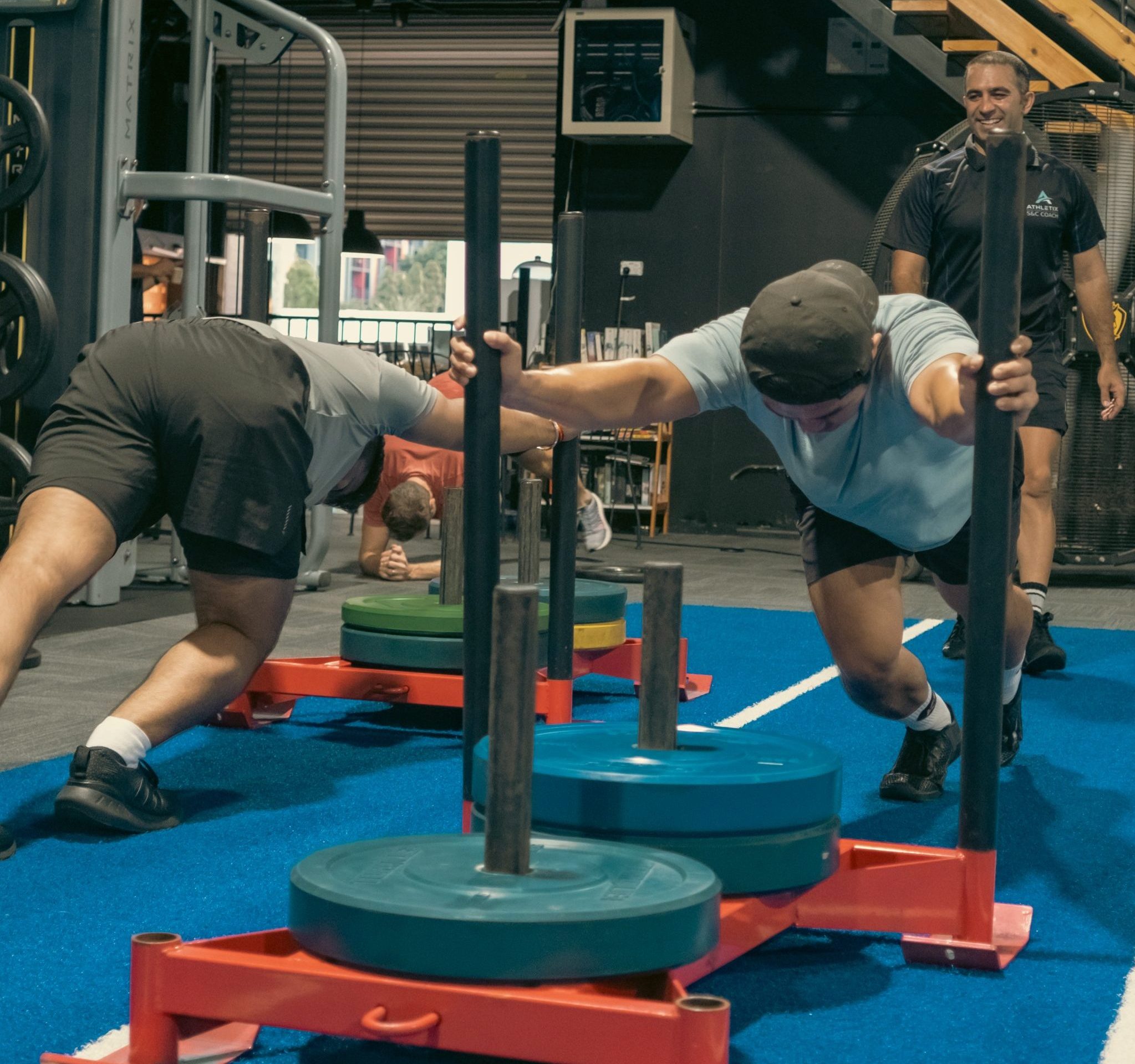
Sprinting sleds are a specialized training tool used to improve speed, power, and overall athletic performance. These sleds are typically weighted and are attached to the athlete via a harness or a rope.
The athlete then sprints while pulling or pushing the sled, adding resistance that challenges their muscles to work harder. This form of resistance training helps enhance explosiveness, stride power, and running mechanics, making it especially beneficial for athletes involved in track and field, football, and other sports that require speed and quick acceleration.
When using sprinting sleds, the added resistance forces the athlete to engage key muscle groups like the glutes, hamstrings, quads, and calves more intensely than during regular sprinting.
This builds strength and muscle endurance, ultimately helping the athlete accelerate faster and maintain high-speed performance for longer durations. Sprinting sleds also aid in improving running form and stride technique, as athletes focus on driving their legs more forcefully and achieving greater stride length and frequency.
Sprinting sleds come with adjustable weights, which allows athletes to tailor their training based on their fitness levels and goals. Progressive overload is key to improving speed and strength, so increasing the weight of the sled over time can lead to greater gains.
This tool is an excellent addition to any speed training regimen, providing an effective way to develop both the power and technique necessary for faster sprinting.
Exploring Sled Training Modalities: From Heavy Loads to Varied Rest Ratios
Heavy vs. Light Load Sled Towing:
Whether you’re an elite athlete or a fitness enthusiast, sled towing offers a scalable and adaptable training stimulus. Based on Kawamori et al.’s findings, incorporating both heavy and light sled loads into your training regimen can yield significant improvements in sprint acceleration ability. Experiment with different loads to optimize your training outcomes and challenge your limits.
Work-to-Rest Ratio Considerations:
The efficacy of RSS isn’t solely determined by the load; the work-to-rest ratio plays a crucial role in dictating training adaptations. Research suggests that shorter rest intervals may enhance metabolic stress and neuromuscular recruitment, while longer rest periods allow for greater recovery and performance sustainability. Tailor your RSS protocol based on your training objectives, considering factors such as intensity, volume, and recovery capacity.
Who Benefits from Sled Training?
– Athletes:
Sled training is a staple in the training programs of athletes across various sports, from sprinters and football players to rugby athletes and track and field competitors. By targeting explosive power and sprint acceleration, RSS can translate to improved on-field performance and competitive edge.
– Fitness Enthusiasts:
Don’t let the term “athlete” deter you—sled training is accessible to individuals of all fitness levels and backgrounds. Whether you’re aiming to boost your speed, torch calories, or enhance muscular strength and endurance, RSS offers a challenging yet rewarding workout experience.
When to Incorporate Sled Training: Practical Applications
Pre-Season Preparation
Integrate sled training into your pre-season conditioning regimen to build a solid foundation of speed, power, and resilience. By progressively loading and varying sled protocols, you can effectively prepare your body for the demands of competition while minimizing the risk of injury.
Off-Season Maintenance
During the off-season, maintain your speed and power gains with regular sled training sessions. Focus on refining sprint mechanics, optimizing force production, and addressing specific performance deficiencies to emerge stronger and faster for the upcoming season.
General Fitness and Fat Loss
Sled training isn’t just for athletes; it’s a potent tool for enhancing overall fitness and torching calories. Whether you’re pushing, pulling, or dragging the sled, each movement engages multiple muscle groups, resulting in a high-intensity, full-body workout that promotes fat loss and metabolic conditioning.
Sled Pulling Sprint Training: Boost Your Power and Speed
Sled pulling sprint training is an effective and dynamic workout that combines strength training with sprinting to enhance both speed and power. By attaching a sled to the athlete and having them sprint while pulling the sled, this exercise creates resistance that forces the body to exert more effort, which helps develop explosive power, accelerate muscle growth, and improve running mechanics.
This training method primarily targets the legs, hips, and core, increasing strength in key muscle groups involved in sprinting. The resistance from the sled builds muscle endurance, improves sprinting form, and boosts overall acceleration, making it ideal for athletes looking to enhance their speed and explosiveness. It also helps improve stride length and frequency, as athletes learn to drive harder with each step.
Sled pulling is versatile and can be adjusted by varying the weight of the sled, allowing athletes to progressively challenge themselves and avoid plateaus. This training technique not only enhances speed but also improves stamina and running technique, making it a valuable addition to any speed training regimen.
In Summary: Harness the Power of Resisted Sled Sprinting
From weighted sled towing to varied work-to-rest ratios, sled training at our Brisbane gym offers a myriad of benefits and applications for athletes and fitness enthusiasts alike. By integrating the insights from peer-reviewed research and practical experience, you can unleash the full potential of RSS to elevate your performance, ignite your passion for training, and achieve your fitness aspirations. So, whether you’re sprinting towards the finish line or striving for personal bests, let sled training be your secret weapon on the journey to athletic excellence and beyond.
FAQs
What is RSS used for?
To deliver automatic updates from websites (like news or blogs).
Is RSS legal in India?
Yes, using RSS feeds is legal in India.
What does RSS represent?
In tech: Really Simple Syndication.
In stats: Residual Sum of Squares.
In India: Rashtriya Swayamsevak Sangh.
What is the RSS formula?
RSS = Σ (Actual − Predicted)²
What is RSS in Total Battle?
In-game resources like food, wood, iron, and gold.
What is the difference between RSS and RMS?
RSS measures total error; RMS measures average magnitude or value.
What are the two types of RSS?
In web: RSS 1.0 and RSS 2.0.
In stats: Total RSS and Partial RSS.
Is higher RSS better?
No, lower RSS means a better model fit.
What does RMS indicate?
Effective or average value of a varying quantity.
What is the full form of RMS?
Root Mean Square
How to calculate true RMS value?
RMS = √[(x₁² + x₂² + … + xₙ²) / n]