Guide to Speed & Agility Training for Youth
Speed and agility are critical components of athletic performance across many sports. Speed refers to the ability to move quickly over a set distance, while agility involves the ability to change direction rapidly and with control. For youth athletes, developing these skills at an early age can not only enhance their ability on the field or court, but more importantly help prevent injury – especially when across maturation stages – and build a foundation for future athletic success. Speed and agility training for youth, however, requires a well-structured, age-appropriate approach. In this guide, we will explore the dos, don’ts, and best practice methods for speed and agility training for young athletes.
Why Speed and Agility Training is Important for Youth
Speed and agility are essential for nearly all sports. Whether in soccer, basketball, tennis, or track, athletes must be able to accelerate quickly, decelerate without losing control, and change direction efficiently. Developing speed and agility at a young age can provide several benefits:
- Improved Athletic outcomes: Speed and agility are vital for performance in competitive sports. Athletes who can move faster and change directions more quickly often have an advantage over their opponents.
- Injury Prevention: Proper training of these skills can help youth athletes learn to decelerate properly and move with control, reducing the risk of strains, sprains, and other injuries.
- Enhanced Coordination and Balance: Speed and agility drills often require coordination, balance, and quick thinking, all of which contribute to overall athleticism.
- Confidence Boost: As young athletes develop these skills, they gain confidence in their physical abilities, which can improve their mental game and foster a positive attitude toward physical activity.
However, like any form of training, speed and agility work must be approached carefully to ensure it’s safe and effective for youth athletes, and compounded by sound and carefully chosen (competency appropriate) strength training.
Do’s of Speed and Agility Training for Youth
- Prioritise Proper Warm-Up and Cool-Down A proper warm-up and cool-down are essential to minimize the risk of injury and improve training outcomes. A dynamic warm-up, followed by some targeted joint mobility and low impact plyometric activity, helps increase blood flow to the muscles, improves flexibility, and prepares the body for explosive movements. After training, a cool-down that includes stretching and low-intensity exercises helps reduce muscle stiffness and improve recovery (Kraemer & Ratamess, 2004).
- Focus on Technique Before Speed: Like resistance training, speed and agility training should begin with a focus on proper technique. Before introducing fast sprints or complex agility drills, athletes must master fundamental movement patterns. Proper sprinting mechanics—such as body posture, arm swing, knee lift, and foot strike—are critical for maximizing speed while preventing injury. Similarly, agility drills like cutting and changing direction should focus on maintaining proper body alignment and control during each movement (Lockie et al., 2017). Athletes should be encouraged to move efficiently rather than just quickly, as poor technique can lead to compensatory movement patterns and increase the risk of injury.
- Incorporate Progressive Overload: Once again, like in resistance training, as youth athletes become more proficient in basic speed and agility drills, the intensity should be progressively increased. Progressive overload involves gradually increasing the difficulty of exercises to challenge the body and promote improvement. This can be done by increasing the number of repetitions, the distance, or the complexity of the drills, as well as introducing higher-intensity intervals (Stone et al., 2007). However, the progression should be gradual to allow the athlete to adapt to the increased load without risking injury or burnout.
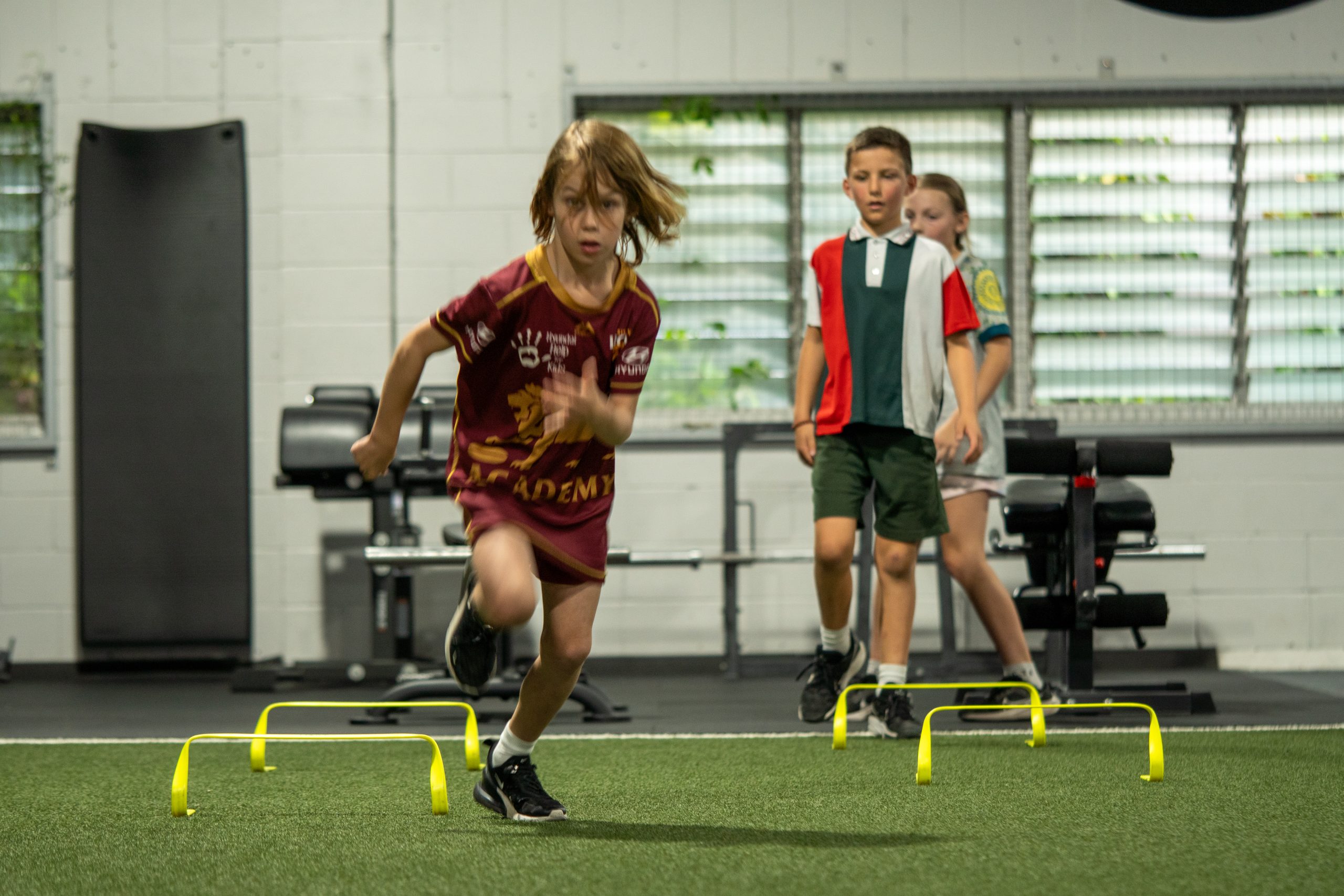
- Use a Variety of Drills A diverse range of drills can help youth athletes develop different aspects of speed and agility, including acceleration, deceleration, lateral movements, and reaction time. For example, short sprints (10-20 meters) help improve acceleration, while ladder drills enhance footwork and coordination. Cone drills and shuttle runs can help improve direction changes and agility. Incorporating a variety of drills ensures that athletes are training all aspects of their speed and agility rather than focusing on just one area.
- Emphasise Multi-Directional Movement Speed and agility training should not just focus on straight-line running. Athletes need to be proficient in multi-directional movements such as lateral shuffling, backpedaling, and pivoting, all of which are essential for most sports. By training in all planes of motion (sagittal, frontal, and transverse), athletes will become more adaptable and capable of handling the demands of various sports situations (Baker & Nance, 1999). Multi-directional drills, such as cone weaves or zigzag sprints, are particularly beneficial for developing agility.
- Allow for Adequate Rest Speed and agility training can be taxing on the body, particularly for youth athletes who are still developing musculoskeletal strength. Overtraining can lead to fatigue, reduced performance, and increased risk of injury. Therefore, rest and recovery should be incorporated into training programs. A good rule of thumb is to allow for 48 hours of rest between intense speed and agility training sessions (Faigenbaum et al., 2010). But also, never have Agility or Speed training sessions after Strength training.
- Train for Explosiveness Explosive power—combining speed with strength—is a key component of agility and overall athleticism. Plyometric exercises like box jumps, jump squats, and bounding can help youth athletes develop the reactive strength needed for quick sprints and rapid direction changes. However, these exercises should only be introduced once an athlete has mastered basic movement patterns and has the strength to handle the demands of plyometric training.
Dont’s of Speed and Agility Training for Youth
- Don’t Skip the Fundamentals It’s tempting to push young athletes to sprint as fast as possible or perform complex agility drills right away, but this can lead to poor technique and injuries. The foundation of speed and agility training should be mastering the basics of movement—such as proper posture, footwork, and body control—before progressing to more advanced drills. Skipping this crucial step can lead to bad habits that are difficult to correct later.
- Avoid Overloading with High-Intensity Training While it’s important to challenge athletes to improve, overloading them with excessive high-intensity training can cause burnout or injury. Youth athletes should avoid long, high-intensity sessions that focus solely on speed and agility work. Instead, sessions should be short (15-30 minutes) but intense, with adequate rest between sets and exercises. Overloading with speed and agility drills without adequate recovery time can be detrimental to an athlete’s development.
- Don’t Focus Exclusively on Speed: Speed is important, but it’s not the only component of agility training. Solely focusing on sprinting at maximum speed without addressing other agility components, such as direction change, deceleration, and re-acceleration, can leave athletes unprepared for real-game situations. Agility requires more than just raw speed—it requires quick thinking, control, and fluidity in movement.
- Avoid Early Specialisation Focusing too early on just one sport or type of speed and agility training can hinder overall athletic development. Youth athletes should be encouraged to engage in a variety of sports and movement activities to develop a broader set of skills. Early sport specialisation can increase the risk of overuse injuries and burnout (Jayanthi et al., 2013). Instead, a well-rounded training regimen that includes multi-sport participation can promote better overall athletic development.
- Don’t Neglect Mental Conditioning: Agility requires not just physical speed but mental sharpness. Decision-making, reaction time, and focus are all critical to performing well in agility drills and in sports competition. Youth athletes should be encouraged to develop their mental focus and concentration during training. Games and drills that challenge an athlete’s cognitive abilities—such as reacting to visual or auditory cues—can help improve mental acuity alongside physical performance (Baker & Nance, 1999).
Best Tips for Speed and Agility Training for Youth
- Integrate Fun and Play To ensure long-term engagement, speed and agility training should be enjoyable. Drills can be made into games or competitions to keep youth athletes motivated. For example, relay races, tag games, or “reaction-based” drills where athletes change direction based on a signal can keep things fun while still focusing on technique and performance.
- Consistency Over Time Consistent practice is key to developing speed and agility. Rather than focusing on short bursts of high-intensity training, encourage athletes to train regularly, 2-3 times a week, allowing for adequate recovery time in between sessions. Over time, consistent training will lead to noticeable improvements in both speed and agility.
- Tailor Programs to Individual Athletes Not all youth athletes are the same, so training programs should be adapted to the individual’s age, experience, and sport-specific needs. Younger athletes (under 12) may benefit more from general coordination and basic movement drills, while older athletes can incorporate more sport-specific agility drills that mimic the demands of their chosen sport (Faigenbaum et al., 2010). Also athletes of the same age might be in different maturation stages.
FAQS
What sports need speed?
Football, soccer, basketball, track and field, rugby, hockey, and tennis all rely heavily on speed.
What is agility training?
Agility training improves the ability to quickly change direction, react, and move efficiently during dynamic movements.
What is speed and agility training?
It’s a combination of drills designed to enhance quickness, acceleration, deceleration, and change of direction.
What training methods improve agility?
Ladder drills, cone drills, plyometrics, shuttle runs, and reaction-based exercises improve agility.
What is speed and agility?
Speed is how fast you move; agility is how quickly and efficiently you change direction while maintaining control.
What is agility and speed?
Agility is the ability to change direction rapidly; speed is the capacity to move quickly over a distance.
What sport uses agility?
Almost all sports use agility — especially basketball, soccer, tennis, football, and martial arts.
What is agility in sport?
Agility is the ability to move and change direction quickly and efficiently during play.
What are the effects of a balanced diet on young athlete performance?
It boosts energy, supports growth, enhances recovery, prevents injuries, and improves focus and endurance.
What is agility in basketball?
It refers to a player’s ability to move quickly, shift directions, and react to plays with control and speed.
Why are my strength and agility sessions on Tuesdays when I want to maximize PVL performance on Sundays?
Spacing sessions early in the week allows recovery time so your body is fresh for optimal performance by Sunday.
Why is agility important?
Agility helps in reacting quickly, avoiding opponents, and maintaining control during rapid direction changes.
Why is agility important in sport?
It enhances performance by allowing athletes to move fluidly, react quickly, and adapt to game situations.
How to develop agility?
Practice cone drills, ladder drills, short sprints, and reaction exercises consistently.
How often should you do speed and agility training?
2–3 times per week is ideal for most athletes to improve without overtraining.
How to train for 800m race?
Combine interval training, tempo runs, strength training, and proper pacing drills to build speed and endurance.
How to increase running speed?
Do sprint intervals, improve technique, build leg strength, and work on form and cadence.
How to increase running speed naturally?
Focus on sprint drills, hill runs, strength training, and proper running mechanics.
How to get faster at running?
Incorporate sprint work, resistance training, and improve stride length and frequency.
How many repetitions of each SAQ drill is appropriate for youth athletes?
3–5 sets of 5–10 reps, focusing on quality over quantity, with adequate rest.
How often should you do agility training?
2–3 times a week, depending on sport demands and recovery.
How to do sprint training?
Include short sprints (10–100m), rest intervals, form drills, and explosive starts in your workouts.
How to get better handles in basketball?
Practice dribbling drills daily — focus on ball control, hand speed, and using both hands under pressure.
Does speed and agility training work?
Yes, when done consistently, it improves quickness, coordination, and sport-specific performance.
Do leg weights make you faster?
Not directly — but strength training your legs can improve power and acceleration if paired with speed work.
Conclusion
Speed and agility training can be incredibly beneficial for youth athletes, improving both their athletic performance and their overall physical development. By adhering to best practices—prioritising proper technique, allowing for adequate rest, and using a variety of drills—you can ensure that youth athletes develop these critical skills safely and effectively. Avoiding overloading, skipping foundational movements, or focusing too much on one aspect of training can prevent injury and foster a more well-rounded athletic development. By integrating fun, consistency, and individualised programming, young athletes can excel in speed and agility training and continue to enjoy and succeed in their sports.
References
- Baker, D., & Nance, S. (1999). The relationship between running speed and measures of strength and power in professional rugby league players.
- Faigenbaum, A. D., et al. (2010). Youth resistance training: Updated position statement paper from the National Strength and Conditioning Association. Journal of Strength and Conditioning Research, 24(4), 1095-1109.
- Kraemer, W. J., & Ratamess, N. A. (2004). Fundamentals of resistance training: Progression and exercise prescription. Medicine and Science in Sports and Exercise, 36(4), 674-688.
- Lockie, R. G., et al. (2017). The effects of speed and agility training on the speed and agility performance of athletes. Journal of Strength and Conditioning Research, 31(8), 2312-2320.
- Stone, M. H., et al. (2007). Principles of training for sports performance: Strength and conditioning for sports. Human Kinetics.
- Jayanthi, N. A., et al. (2013). Sports specialization in young athletes: Evidence-based recommendations. Sports Health, 5(3), 251-257.